




NEWS
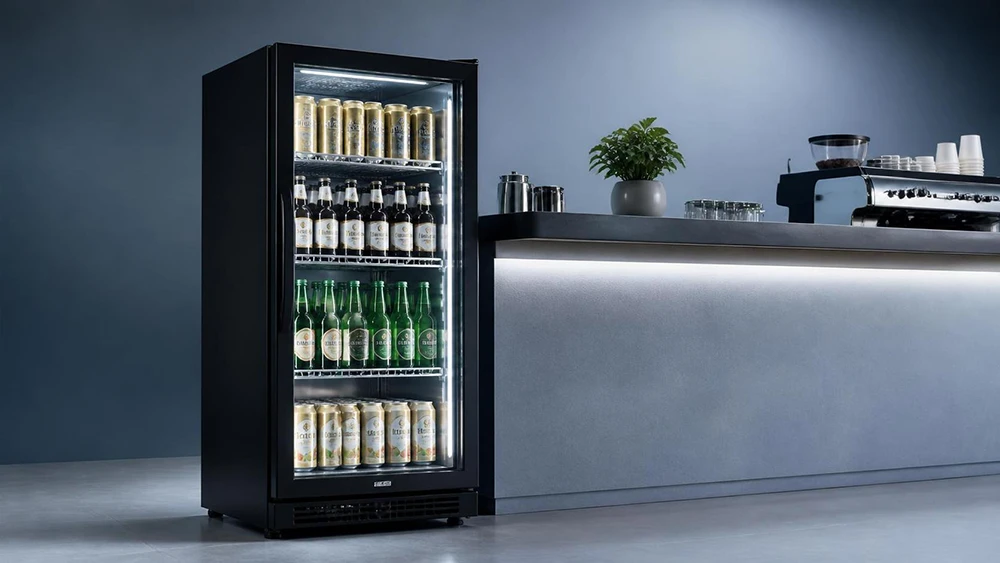
If you are buying a small beer showcase for a cafe counter, kiosk, or a narrow beverage corner, the real question is not just “Which model is cheapest?” It is “Which unit will actually hold the right stock, keep drinks cold during busy hours, fit the space, and avoid service issues six months later?” In compact commercial spaces, a poor buying decision usually shows up fast: blocked workflow, uneven cooling, wasted electricity, or a showcase that looks fine on paper but does not suit the selling environment.
The better approach is to treat this as a layout-and-lifecycle purchase, not just a box-with-a-door purchase. Size, door style, shelf design, airflow, ambient conditions, and after-sales support matter more than many buyers expect.
What a small beer showcase should solve in a real business setting
In small-format beverage sales, refrigeration is doing two jobs at once. It stores product safely and it helps sell product visually. That second part is where many procurement decisions go wrong.
A showcase placed near a cashier counter or in a kiosk is often chosen mainly by outer dimensions. That is understandable, but it is incomplete. In actual use, the unit also needs to open easily in a tight aisle, recover temperature after frequent door openings, and display labels clearly enough that customers make quick choices without asking staff to explain every option.
A good small beer showcase should help with:
- fast product visibility in a limited footprint
- stable cooling during repeated door opening
- reasonable power consumption for long daily operating hours
- easy cleaning in foodservice or retail environments
- stock organization for cans, bottles, and mixed beverage SKUs
That is the short answer many buyers need: choose the unit that fits your sales pattern, not just your available floor space.
Start with the sales pattern, not the cabinet dimensions
Before comparing specifications, confirm what the showcase will actually hold. Beer in slim cans, standard cans, stubby bottles, and long-neck bottles all use shelf space differently. A unit that looks large enough by gross liter capacity can still be frustrating in daily use if shelf spacing wastes vertical space or forces awkward product arrangement.
There are three questions worth settling early:
How many SKUs need to be visible at the same time?
If the business sells only two or three beer brands, a narrower upright unit may be enough. If the goal is visual variety, adjustable shelving becomes more important than total volume.
How often will the door be opened?
A self-service beverage corner sees far more openings than back-of-house storage. Frequent opening puts pressure on cooling recovery, especially in hot weather or near cooking equipment.
Is this for fast turnover or display support?
High-turnover sites need cooling performance and ergonomic restocking first. Lower-turnover sites often care more about front presentation, quiet operation, and energy use.
Buyers who answer these questions early usually avoid the classic mistake of overspending on features they do not need, while underbuying on the features that actually affect daily operations.
Capacity can mislead you if you read it too literally
One of the easiest traps in refrigeration procurement is relying too heavily on nominal capacity. The number in liters is useful, but only as a rough comparison. It does not tell you how many saleable units fit neatly, how much dead space exists between shelves, or whether larger bottles will force you to remove a shelf and reduce total display rows.
In a compact beverage corner, practical capacity matters more than headline capacity. Ask for the internal shelf layout, shelf load rating, and recommended product arrangement. If a supplier cannot clearly explain how the cabinet handles mixed beverage formats, that is already a warning sign.
For limited-space sites, a slightly smaller showcase with smarter shelf use is often the better buy than a larger cabinet that creates clutter or poor visibility.
Glass door type matters more than many people think
For a small beer showcase, the door is not a minor detail. It affects energy performance, user convenience, cleaning effort, and how premium the drinks look in-store.
Hinged doors are common and usually simple to maintain. They work well when there is enough clearance in front of the unit. In a kiosk or narrow service lane, though, the swing path can interfere with staff or customers.
Sliding doors save front clearance, which is useful in tight layouts. The trade-off is that some sliding-door designs offer a slightly narrower access opening and may need more attention to track cleaning.
Double-layer tempered glass with anti-fog performance is worth considering in warm, humid environments. If the glass fogs up during rush hours, product visibility drops and impulse sales suffer. Buyers sometimes treat anti-condensation features as optional, then regret it after installation.
Cooling system choices: where cost and performance really meet
Procurement teams often focus on upfront price because that number is immediate and easy to compare. The problem is that refrigeration ownership cost does not stop at the invoice.
A lower-priced showcase may still cost more over time if it struggles with temperature recovery, runs loudly, consumes more electricity, or needs repeated servicing. That is why it is better to look at operating conditions together with hardware quality.
Check these points carefully:
- temperature range suitable for packaged beer and bottled beverages
- cooling consistency from top shelf to bottom shelf
- performance in high-ambient commercial environments, which should be verified with the supplier
- defrost method and how it affects maintenance
- compressor and fan quality, especially for long daily runtime
If the unit will sit near coffee equipment, under strong afternoon sun, or in a semi-open kiosk, ask more questions than usual. Compact spaces often have worse heat conditions than larger stores, and that can expose weak refrigeration systems quickly.
Energy use is not only about the utility bill
Yes, electricity cost matters. But energy efficiency also affects heat rejection into the room, compressor workload, and how hard the unit needs to work during peak periods.
In a small beverage corner, excess heat from refrigeration equipment can make the surrounding area less comfortable for staff and can raise the load on other cooling systems. That is one reason an “economical” unit is not always economical in practice.
Ask suppliers what conditions their energy figures are based on. If no testing basis is provided, treat any claim carefully. Real consumption depends on ambient temperature, door opening frequency, thermostat setting, loading pattern, and maintenance condition.
For long-hour operations, LED lighting, reliable door sealing, and stable fan control usually deserve more attention than decorative features.
Space planning details that buyers often miss
Most sizing mistakes happen outside the cabinet, not inside it.
A small beer showcase needs clearance for ventilation, door movement, cleaning access, and restocking. If a cabinet is pushed too tightly into millwork or corner walls, cooling efficiency can drop and service access becomes painful. In custom retail fit-outs, this is common.
It is also worth checking:
- whether the floor is level and strong enough for a loaded cabinet
- power supply compatibility for the destination market
- plug location and cable routing
- whether the unit must pass through narrow doors, lifts, or stair access before installation
These are not glamorous points, but they are exactly the kind that delay projects or add unplanned cost.
When a small beer showcase is the right choice, and when it is not
This type of unit is a strong fit for front-of-house retail display, compact grab-and-go beverage sales, and secondary merchandising near checkout areas. It is especially practical where a full-size upright merchandiser would overpower the layout.
It is a weak fit for sites that need bulk cold storage, very high stock rotation with minimal restocking labor, or mixed use with unstable temperature-sensitive products requiring tighter control. In those cases, a back-bar cooler, undercounter chiller, or larger display refrigerator may serve the operation better.
That distinction matters because many buyers try to make one refrigerator solve every problem. Small showcases work best when their role is clearly defined.
Sourcing: what to ask before placing the order
Once the shortlist is down to two or three models, the buying conversation should move beyond appearance and price. This is where supplier capability starts to matter.
Ask about manufacturing consistency, inspection process, export experience, parts availability, and customization limits. If your project involves private label, special dimensions, branding, or market-specific electrical standards, factory coordination becomes much more important than it is for off-the-shelf retail buying.
Baisite, based in Xingfu Town, Binzhou, Shandong Province, is one example of a source factory model that many buyers prefer for this kind of procurement. The company integrates R&D, sheet metal processing, complete machine production, quality inspection, export trade, and OEM/ODM customization, with more than ten years of experience in commercial freezer and chiller manufacturing. That kind of structure can be useful when the requirement is not just “send me a standard fridge,” but “match my market, my dimensions, and my order workflow.”
That does not mean every project needs customization. It means buyers should know whether they are buying a standard unit, a modified standard unit, or a fully customized solution, because each path has different lead times, costs, and risk points.
Common buying mistakes
One mistake is overvaluing appearance and undervaluing thermal performance. A clean black frame and bright lighting look good in a catalog, but poor airflow or weak insulation will show up fast in operation.
Another is assuming all compact display refrigerators are interchangeable. They are not. Similar outer dimensions can hide major differences in evaporator design, insulation quality, shelving flexibility, and service life.
The third is skipping after-sales questions because the order quantity is small. Even one failed showcase in a kiosk can interrupt sales immediately. Spare parts response, warranty terms, and technical support still matter.
A practical way to compare final options
If you are choosing between several models, build a simple scoring sheet. Do not make it overly complicated. Score each unit on these five points:
- layout fit
- real display capacity
- cooling stability under expected use
- operating cost and maintenance risk
- supplier responsiveness and documentation quality
This method helps keep the decision grounded. A unit that is slightly higher in purchase price may still be the better procurement result if it fits better, sells better, and causes fewer service issues.
Near the end of the process, ask the supplier to confirm the final configuration in writing: dimensions, voltage, plug type, temperature range, door style, shelf quantity, finish, branding requirements, packaging method, and lead time. That small discipline prevents a surprising number of avoidable disputes.
Final thought
The right small beer showcase is rarely the one with the lowest quotation or the biggest capacity number. It is the one that suits the retail format, holds the right beverage mix, recovers temperature quickly, and keeps operating cost under control in a tight commercial space. When buyers focus on real use conditions instead of brochure claims, they usually make a much better call.
FAQ
How small is “small” for a beer showcase?
There is no universal cutoff. In procurement terms, it usually means a compact display refrigerator selected for limited front-of-house space rather than bulk storage. Always judge by usable footprint and internal shelf layout, not by label alone.
Is a glass-door showcase suitable for very hot locations?
It can be, but performance depends on cabinet design, insulation, glass quality, and ambient conditions. If the site is hot or semi-open, ask the supplier to confirm suitable operating conditions before ordering.
Should I choose sliding doors or hinged doors?
Choose sliding doors when front clearance is tight. Choose hinged doors when wider access for loading and cleaning matters more and you have enough opening space.
Is customization worth it for a small order?
Only when the standard model creates a real problem, such as wrong voltage, size mismatch, or branding requirements. For straightforward projects, a proven standard unit is often the faster and lower-risk option.
What should I confirm before payment?
Final dimensions, voltage, temperature range, door type, shelf configuration, packaging, warranty terms, and delivery lead time. Those details matter more than a polished product photo.
Internal link anchor text suggestions
- commercial display refrigerator buying guide: category page or knowledge article
- back bar cooler vs upright showcase: comparison article
- OEM refrigeration equipment manufacturer: factory service page
- how to choose a commercial beverage cooler: educational blog post
- custom commercial refrigeration solutions: customization landing page
External source directions for citation
- official energy-efficiency guidance from government or regulatory agencies
- brand official technical documentation for compressors, temperature controllers, or refrigeration components
- foodservice or refrigeration industry association materials on commercial refrigeration operation and maintenance
 Food Safety Points to Check When Choosing a Refrigerated Worktable for Prep Areas
- Commercial Deep Freezer Energy Costs: What Buyers Should Calculate Before Ordering
- What Is a Commercial Drink Fridge and Where Is It Most Useful in Foodservice Operations?
- Small Beer Showcase Buying Guide for Cafes, Kiosks, and Limited-Space Beverage Corners
- What Makes an Ice Cream Glass Display Freezer Suitable for High-Traffic Retail Stores?